
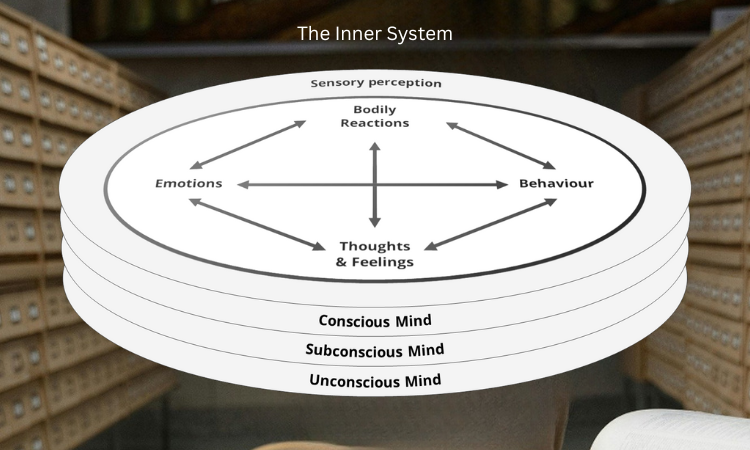
Many coaches go deeper by focusing on one dimension of change — but what if the real breakthrough comes from seeing the whole Inner System first?
There often comes a moment in a coach’s professional journey when the foundations are solid. You’ve built your practice, developed your style, and worked with a wide range of clients. You’re no longer preoccupied with the basics – you’re ready to go deeper.
For many, this is the point where specialisation begins. Some coaches are drawn towards working more with emotions, others towards the body, mindfulness, parts work, neuroscience or subconscious dynamics. These deep dives can be transformative, both personally and professionally.
But there’s a subtle trap here. By focusing on a single dimension in depth, it’s easy to lose sight of how the different layers of human experience interact. One coach might develop exquisite skill in somatic work but overlook how thoughts and beliefs shape bodily reactions. Another might become adept at working with emotions but find it harder to integrate those insights into behavioural change.
It’s not that these approaches are wrong – far from it. The issue is that without a clear map of how the various elements work together, our coaching can become fragmented. We deepen one channel while leaving others implicit, and as a result, the overall impact can plateau.
This is where the Inner System offers a valuable lens.
The Inner System refers to the dynamic interplay between thoughts, emotions, bodily sensations and subconscious processes. These elements don’t operate in isolation; they constantly influence one another, often outside our clients’ conscious awareness. Many of the most persistent challenges in coaching – those moments when insight doesn’t lead to action – can be traced back to subconscious blockages within this system.
Take a simple example: a client wants to speak up more in senior meetings. Cognitively, they understand why it matters. Emotionally, they feel anxious. Physically, their throat tightens. Subconsciously, a story plays out: “If I speak up, I’ll be exposed.” Each of these elements – thoughts, emotions, body, subconscious – reinforces the others, creating a self-sustaining loop that insight alone rarely shifts.
As coaches, when we choose to deepen our practice in just one of these domains, we’re adding a powerful tool. But if we first understand the Inner System as a whole, that deep dive becomes far more effective. We can see where the chosen approach fits, how it connects to other layers, and where its limits might be.
In my experience, this systems-level understanding often acts like adjusting the focus on a camera lens. The picture suddenly becomes clearer. A coach who has specialised in emotional work starts noticing subtle body cues that signal deeper patterns. Someone trained in cognitive approaches realises that their clients’ emotional and physical responses aren’t secondary – they’re integral.
This doesn’t mean we have to master everything at once. Rather, it’s about making the architecture of change explicit, so we can navigate it more consciously.
One experienced coach I worked with had trained extensively in mindfulness-based approaches. Her sessions were beautifully attuned, yet some clients stayed stuck despite their growing awareness. Once she began framing her work through the lens of the Inner System, she could see how emotional avoidance and subconscious blockages were quietly shaping what happened in the room. It didn’t invalidate her mindfulness skills – it amplified them.
Working with the Inner System isn’t about abandoning your specialism. It’s about contextualising it within a broader, evidence-based map of how human change happens. For seasoned coaches, this often brings renewed energy and depth to their practice.
The moment you decide to go deeper is a pivotal one. By first understanding how the Inner System’s elements interact, you set yourself up to use your chosen methods with greater precision, integration and impact.
In my experience, the real leap forward often comes not from another deep dive, but from learning to see the whole picture.
Felix Müller, PCC (ICF), founder of the Academy for Cognitive Behavioural Coaching (ACBC), is an experienced executive coach and trainer. With an MSc in Coaching and Behavioural Change from Henley Business School and 25+ years’ leadership experience, Felix combines scientific depth with practical insight. He supports leaders in overcoming stress and subconscious blockages, and helps experienced coaches deepen their practice by integrating cognitive, emotional, somatic and subconscious dimensions.
Academy for Cognitive Behavioural Coaching (ACBC) are a TCD Trusted Provider.