
...two years in, my wife and kids are fed up with me moping round the house. She says I need to get a hobby! I try to stay super positive on LinkedIn, like everyone else but that’s now wearing thin.
Part One – CEO
Two years ago, Rob was CEO of a £2 billion construction contractor with 2,000 people under him. He had been in post for five years, having worked his way through the ranks since joining the company 40 years ago, straight from university. His period in charge was very successful, with the company enjoying positive growth on all metrics.
He started out as a site civil engineer, gained chartered status just as he turned 30 and made steady progress up the corporate ladder, reaching the top at 50.
As a civil engineer, his real passion and focus was on the technical side of the business. Out of necessity, however, over the last 10 years his attention turned more towards finance and people – though he considered neither to be real strengths. He argued that his success as CEO was mainly down to his longstanding business relationships with Simon, the Finance Director and Amy, the HR Director. All three were regularly in the same office working through issues of the day and planning for the future – perhaps an unusual trio for construction leadership.
Rob spent many hours in discussion with both Simon and Amy in the year prior to leaving, sharing and developing his thinking about this new phase of his career. He also had coaching with me after completing my The Executive Focus Planner exercise in the middle of that year.
Everyone expected Rob to walk straight into another senior executive role or to develop a non-exec portfolio, or even to head up a technically challenging mega project.
He surprised all when he announced he was going to become a coach.
Reflecting, he told me that he considered the people side of business to be an area where he had most to learn and was somehow drawn to that. I asked him why and he explained that one of his proudest initiatives in recent years was setting up and running the Fast Track to The Board programme. Thirteen high-flyers were identified and he met one of them each week for two hours on a 13-week rotation.
He loved these weekly meetings, finding out about the individuals, their issues and thinking, and of course challenging them onwards and upwards. He also admitted that he liked it most when they got into discussing the technicalities of engineering, but checked and forced himself and the discussion back to personal or strategic matters.
So, it was decided – Rob was going to be a coach. Working from home, his wife and grown-up children were initially delighted.
Part Two – Coach
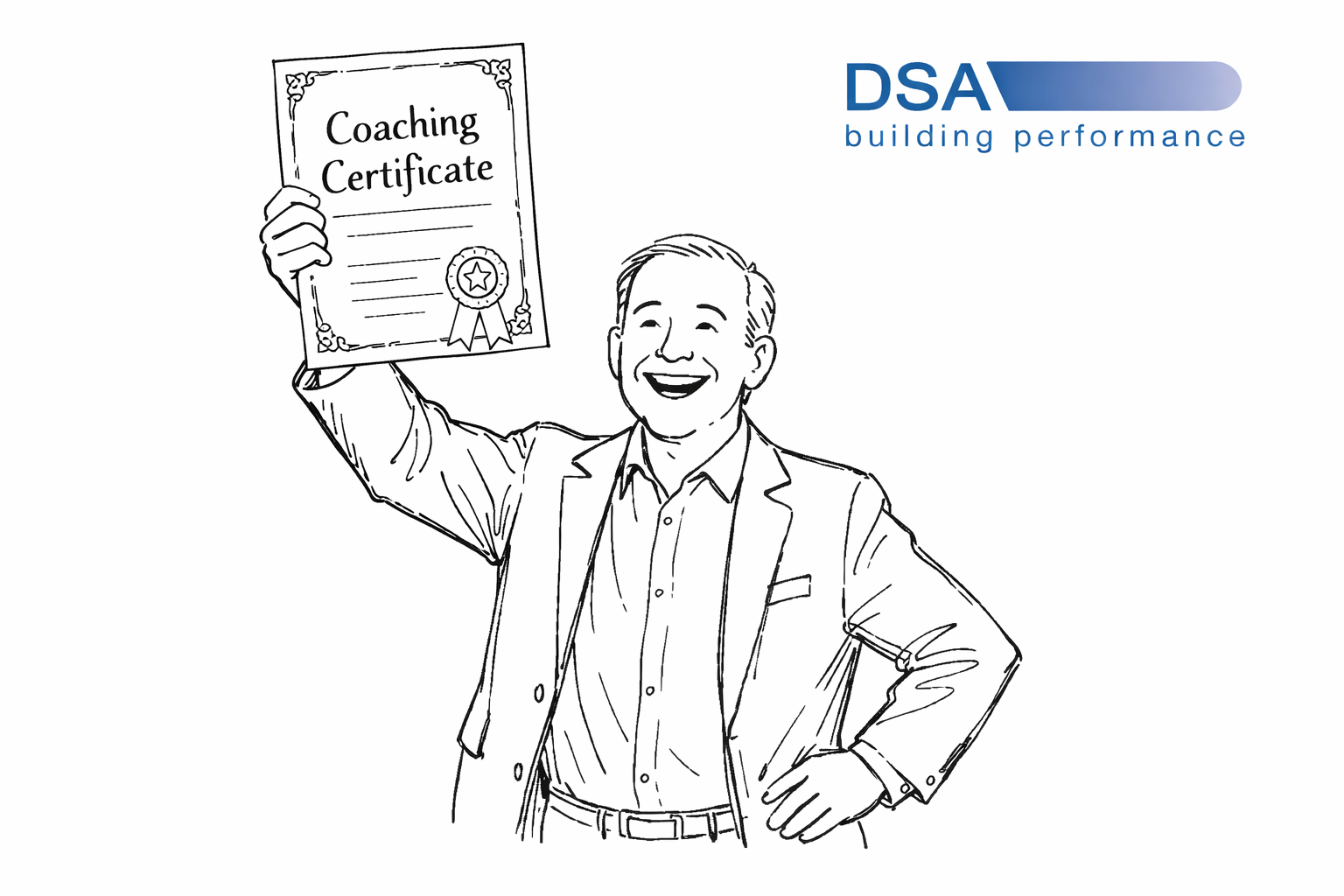
Rob said he wanted to be a “proper” coach, so did a year-long certificate programme at his local university. For this he had to attend night classes, two three-day modules, complete a series of assignments, including a final dissertation and accrue 90 hours of coaching with regular supervision. He was also required to provide several demonstrations of him coaching volunteers while being observed by faculty. He found these to be particularly nerve-wracking with robust, though very useful, feedback.
A second-year option was available to gain a Master’s degree.
He found the certificate level programme demanding and decided not to carry on for the more academic Master’s, saying he was now a “trained coach” and was happy with that as a base, though still aspired to become a professionally qualified coach in time. He equated his current level qualification as equivalent to a graduate civil engineer aspiring to become a chartered civil engineer.
Presently, Rob has a mix of work. He was retained by his company to continue the weekly sessions with the high-flyers, though reduced to one hour per week. He is working with a friend’s son on a pro bono basis, who is grappling with his ‘stalled career’. He has had four speaking engagements, all unpaid, along with several guest podcast appearances; enjoyable though also unpaid. Despite his considerable contact book, he has failed, as yet, to land regular coaching work with other organisations, though has done several chemistry sessions and submitted numerous proposals. He has done a handful of one-off sessions with other CEOs looking to get his opinion on their various executive issues, again all pro bono – hoping they lead to something.
Seven months post-coach training, Rob is getting frustrated, concerned that his years of executive experience doesn’t seem to distinguish him from all the executive coaches on LinkedIn. He rang Amy to see if he might coach some of the senior managers at his old firm – she seemed hesitant and said she would ask around and get back to him. She rang back a week later and said she was worried that senior managers would be intimidated by him and the three Board members open to coaching were working with MCC coaches.
The day after this, Rob rang me and said, “Dave, you’re an MCC coach, what’s one of them?” I explained and he said, “Right, so I’m a newbie coach in amongst a world of executive coaches and it’s going to take me 10 to 15 years to become a Master Certified Coach?”
He then asked, “What was it like for you when you started out 25 years ago?”
“Very different,” I replied. “There were only a few coaches in the whole construction industry. Now a quick Google search reveals about three million people who have ‘coach’ in their job title and there’s also AI, which I am told does a good job of entry level coaching.”
“What about MCCs in the UK?” he asked.
“There are about 100 and, as far as I can tell, about 90 women and 10 men for whatever difference that makes. And only one, me, who works solely in the construction industry, is a chartered civil engineer and chartered builder, and mainly does leadership team coaching. “And it can take me years to land a team coaching assignment, though I usually have a few on the go at any time. It’s not an easy life given all those executive coaches are now leadership team coaches as well – ever since team coaching became the next big thing about five years ago.”
Rob vented his frustration … “I don’t need the money, it’s not about that. I want to be useful, I want to learn about people, I want to be a good coach, to give back. When I was an exec I really didn’t know about coaching. It’s a very different thing to the various consultants we used and I now know how powerful it can be for people right through the organisation. I want to get in somewhere, somehow and give it a right good go.
“And the thing that’s really frustrating, it freaks me out … my phone just doesn’t seem to ring anymore. I reach out to long-established relationships and get no reply. Even Simon. I rang him a fortnight ago and haven’t heard back from him. What’s that about?! And two years in, my wife and kids are fed up with me moping round the house. She says I need to get a hobby! I try to stay super positive on LinkedIn, like everyone else but that’s now wearing thin.
“What do you think I should do Dave? What would you do if you were starting out now? I know you’re not going to answer that, ’cos you’re a coach and you don’t give advice.”
“Rob, I will answer it because we’re not coaching here are we. Honestly, I don’t know what I would do and probably wouldn’t start out now. I tell you what though, how about we do The Executive Focus Planner again? It’s getting on three years since your last one. And it’s for all humans, not just execs.”
“Ah, brilliant idea Dave, that fills me with hope!”
Master Certified Coach: What is an MCC? : Certification Credly
Leadership Team Coach Dave Stitt works with construction industry executives and project teams enabling them to deliver remarkable results in a remarkable way.
Dave is the creator of Coach for Results, an accessible online course teaching the basics of a coaching management style so managers can grow confidence, capability and enthusiasm in the people around them.
Read more blogs from Dave – ‘All in an instant – in the pool and at work’
+ 3 more
48 years experience in construction industry, last 24 as leadership team coach